Tolerating Evil is not a Virtue

Ever wondered how silent acceptance can erode justice over time?

Tolerance must have boundaries. Without them, it can trigger chaos, not peace.

Imagine ignoring small injustices daily—eventually, it fuels significant unrest

Will you stand up for what’s right, or stay silent?

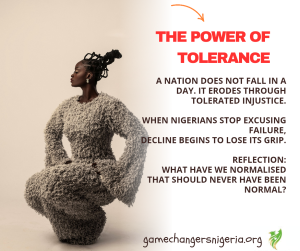
A nation does not fall in a day.
It erodes through tolerated injustice.
When Nigerians stop excusing failure,
decline begins to lose its grip.

Reflection:
What have we normalised that should never have been normal?

#nigeria #tolerance #society #wisdom #socialnorms

Discover Unlimited Potential with Our GC Peer-to-Peer Model!

Unlock various opportunities while connecting with like-minded individuals. Our peer-to-peer model empowers you to:

✔️ Build a connected economy
✔️ Collaborate and grow within a supportive community
✔️ Earn GC Point, your gateway to income here

Don’t wait—step into a world of possibilities today!

To become a Leader and Ambassador, Click Link Now 

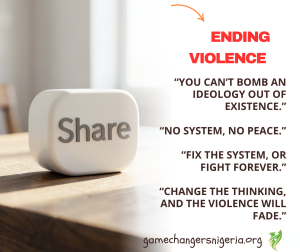
Ending Terrorism


You can send soldiers.
You can drop bombs.
You can win battles.

But hear this truth:

You can’t bomb an ideology out of existence.

Violence is not born on the battlefield.
It is born in the mind—
fed by broken systems, false beliefs, and ignored communities.

That is why this matters:

No system, no peace.

When the system that produces anger, fear, and radical thinking remains untouched,
violence will always return—
under a new name, a new group, a new face.

So we must choose wisely:

Fix the system, or fight forever.

Real peace begins when:

  • Minds are educated
  • Communities take responsibility
  • Truth replaces lies
  • Hope replaces despair

And when that happens, something powerful follows:

Change the thinking, and the violence will fade.

Peace is not enforced.
Peace is built.


Discover Unlimited Potential with Our GC Peer-to-Peer Model!

Unlock various opportunities while connecting with like-minded individuals. Our peer-to-peer model empowers you to:

✔️ Build a connected economy
✔️ Collaborate and grow within a supportive community
✔️ Earn GC Point, your gateway to income here

Don’t wait—step into a world of possibilities today!

To become a Leader and Ambassador, Click Link Now 

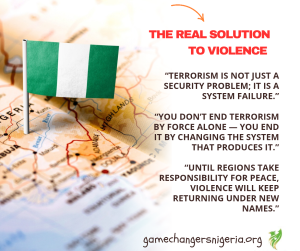
Terrorism is not just a security problem, It is a system failure.

The Real Solution

Terrorism is not just a security problem.
It is a system failure.

You can send more soldiers.
You can buy more weapons.
You can win battles.

But if the system that produces fear, false beliefs, neglect, and hopelessness remains, violence will return — wearing a new name.

You don’t end terrorism by force alone.
You end it by changing the system that creates it.

Until regions take responsibility for their own peace, values, education, and development, violence will keep recycling itself — from group to group, generation to generation.

Real peace begins when communities own their future, reject destructive ideas, and build systems that reward life, not death.

Discover Unlimited Potential with Our GC Peer-to-Peer Model!

Unlock various opportunities while connecting with like-minded individuals. Our peer-to-peer model empowers you to:

✔️ Build a connected economy
✔️ Collaborate and grow within a supportive community
✔️ Earn GC Point, your gateway to income here

Don’t wait—step into a world of possibilities today!

To become a Leader and Ambassador, Click Link Now 

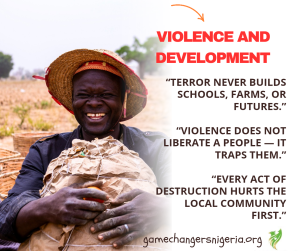
Violence and Development

Terror never builds schools, farms, or futures.

It leaves classrooms empty, farmlands abandoned, and dreams buried under fear.

Violence does not liberate a people — it traps them.
It steals time, destroys trust, and turns communities into battlegrounds instead of homes.

Every act of destruction hurts the local community first.
Before the headlines fade, it is families, children, traders, farmers, and neighbours who pay the price.

Peace is not weakness.
Development is not betrayal.
And no society ever rose from the ashes of its own destruction.

#PeaceOverViolence
#EndTerrorism
#BuildNotDestroy
#NoFutureInViolence
#AfricaRising
#NigeriaForPeace
#BreakTheCycle
#StopTheBloodshed
#ChooseDevelopment
#CommunitiesMatter
#YouthForPeace
#HopeOverHate

Discover Unlimited Potential with Our GC Peer-to-Peer Model!

Unlock various opportunities while connecting with like-minded individuals. Our peer-to-peer model empowers you to:

✔️ Build a connected economy
✔️ Collaborate and grow within a supportive community
✔️ Earn GC Point, your gateway to income here

Don’t wait—step into a world of possibilities today!

To become a Leader and Ambassador, Click Link Now 

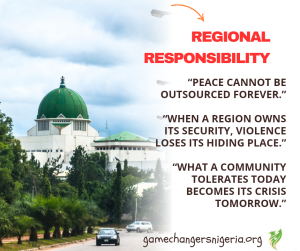
Regional Responsibility

Peace cannot be outsourced forever.
No nation can continue to depend solely on distant authorities or external forces to solve deeply local problems. When insecurity is born within a region, that region must rise to confront it—morally, socially, and structurally.

When a region owns its security, violence loses its hiding place.
Criminality and extremism thrive where responsibility is blurred and accountability is distant. But when communities take ownership—through shared values, local leadership, and collective vigilance—violence finds no shelter.

What a community tolerates today becomes its crisis tomorrow.
Silence, indifference, or justification of violence only postpones the damage. Every act ignored grows bolder, deeper, and more destructive. Peace is preserved not by denial, but by early responsibility.

True security begins when regions accept that their peace, progress, and future are in their own hands.

#RegionalResponsibility
#PeaceStartsAtHome
#SecurityIsLocal
#EndViolence
#CommunityFirst
#FixTheSystem
#NigeriaMustWork
#BreakTheCycle
#NationBuilding
#TruePeace
#NoMoreTerror
#CollectiveResponsibility
#ChangeTheNarrative

Discover Unlimited Potential with Our GC Peer-to-Peer Model!

Unlock various opportunities while connecting with like-minded individuals. Our peer-to-peer model empowers you to:

✔️ Build a connected economy
✔️ Collaborate and grow within a supportive community
✔️ Earn GC Point, your gateway to income here

Don’t wait—step into a world of possibilities today!

To become a Leader and Ambassador, Click Link Now 

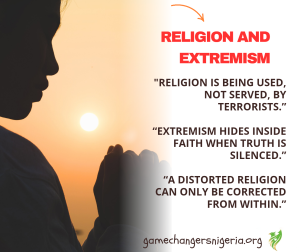
Religion and Extremism

Religion was never designed to destroy lives or communities. Yet across the world, we see how terrorists twist faith into a weapon, not to serve God, but to serve power, fear, and control.

Religion is being used, not served, by terrorists. They borrow sacred language to justify actions that contradict the very essence of faith—compassion, justice, mercy, and peace.

Extremism hides inside faith when truth is silenced. When questioning is forbidden, when education is denied, and when fear replaces understanding, false doctrines grow unchecked.

A distorted religion can only be corrected from within. Guns cannot fix belief systems. Airstrikes cannot heal broken ideologies. Only authentic voices from within the faith, grounded in truth and moral courage, can dismantle extremism and restore the true meaning of religion.

Until this happens, violence will continue to recycle itself under different names.


Discover Unlimited Potential with Our GC Peer-to-Peer Model!

Unlock various opportunities while connecting with like-minded individuals. Our peer-to-peer model empowers you to:

✔️ Build a connected economy
✔️ Collaborate and grow within a supportive community
✔️ Earn GC Point, your gateway to income here

Don’t wait—step into a world of possibilities today!

To become a Leader and Ambassador, Click Link Now 

Boko Haram and Similar Groups

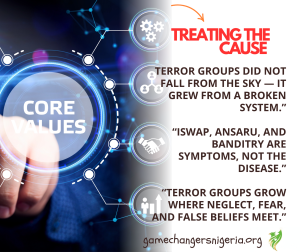
Boko Haram did not fall from the sky.

It did not appear overnight, and it was not created by chance.

It grew from a broken system — a system where poverty, neglect, weak governance, and distorted beliefs were allowed to coexist for too long.


Groups like ISWAP, Ansaru, and widespread bandit networks are not isolated problems. They are symptoms, not the disease itself. When one group is weakened, another emerges under a new name because the underlying conditions remain untouched.


Terror groups grow where neglect meets fear, where hopelessness meets manipulation, and where false beliefs are allowed to replace truth. When young minds are left without opportunity, education, or hope, extremism finds easy recruits.


Until we fix the system that produces these conditions — socially, economically, ideologically, and regionally — violence will keep resurfacing.

You cannot end terror by force alone; you must dismantle the environment that sustains it.

Discover Unlimited Potential with Our GC Peer-to-Peer Model!

Unlock various opportunities while connecting with like-minded individuals. Our peer-to-peer model empowers you to:

✔️ Build a connected economy
✔️ Collaborate and grow within a supportive community
✔️ Earn GC Point, your gateway to income here

Don’t wait—step into a world of possibilities today!

To become a Leader and Ambassador, Click Link Now 

Violence begins in the mind long before it reaches the hand

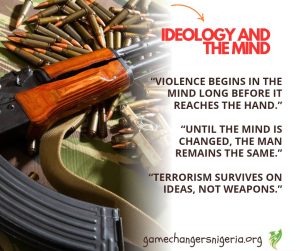
“Violence begins in the mind long before it reaches the hand.”

No act of violence happens suddenly. Before a gun is lifted, before a bomb is planted, before a machete is raised, a thought has already been accepted. Violence is first imagined, then justified, then normalised. By the time it reaches the hand, the mind has already been convinced that the act is right, necessary, or even holy.

This is why stopping violence only at the physical level is never enough. You may stop an attack today, but if the thinking that produced it remains untouched, another hand will rise tomorrow. The real battlefield is the mind — where ideas are planted, fears are nurtured, and hatred is taught.


“Until the mind is changed, the man remains the same.”

Behaviour is a product of belief. You cannot expect a man to act differently while he still thinks the same way. If his worldview tells him that killing is justified, that destruction is honourable, or that violence brings reward, then no amount of punishment or military pressure will truly reform him.

Real change happens when the mind is re-educated, when false narratives are challenged, and when a new understanding of value, dignity, and purpose is introduced. Without this inner shift, any outward calm is temporary. The man may pause, but he has not changed. Transformation begins where thinking changes.


“Terrorism survives on ideas, not weapons.”

Weapons are tools; ideas are fuel. Terrorist groups collapse when their ideas lose influence, not when their weapons are seized. History has shown that arms can be replaced, fighters can be recruited, and camps can be rebuilt — but when people stop believing the ideology, terrorism starves.

Terrorism feeds on narratives of injustice, superiority, entitlement, and promised reward. It grows where ignorance is protected and critical thinking is absent. This is why the most powerful weapon against terrorism is not the gun, but a stronger idea — one that offers meaning without violence, identity without hatred, and purpose without destruction.


In Summary

Violence is first a thought. Terrorism is first an idea.
And peace, too, must begin in the mind.

If the mind is reached, the hand will follow.

Discover Unlimited Potential with Our GC Peer-to-Peer Model!

Unlock various opportunities while connecting with like-minded individuals. Our peer-to-peer model empowers you to:

✔️ Build a connected economy
✔️ Collaborate and grow within a supportive community
✔️ Earn GC Point, your gateway to income here

Don’t wait—step into a world of possibilities today!

To become a Leader and Ambassador, Click Link Now 

Chapter 8 (3): What Great Leaders Across Have In Common


Great leaders, regardless of their cultural, social, or geographical background, share several key traits and qualities that enable them to inspire, influence, and lead others effectively. Here are some common characteristics that define great leaders across the world:

1. Vision


Great leaders have a clear and compelling vision for the future. They are able to see beyond the present challenges and create a roadmap to success. Whether it’s political leadership, corporate governance, or social movements, leaders like Nelson Mandela, Martin Luther King Jr., and Steve Jobs all had visionary ideas that motivated others to follow them.

2. Integrity


Integrity is a cornerstone of leadership. Leaders with strong moral principles and a commitment to honesty build trust and credibility with their followers. For example, Mahatma Gandhi’s unwavering commitment to truth and non-violence garnered him global respect and following.

3. Empathy


Great leaders understand and care about the emotions, needs, and aspirations of their people. They are able to connect on a personal level, making their followers feel valued. Leaders like Jacinda Ardern, the Prime Minister of New Zealand, have shown how empathy, especially during crises, can strengthen a leader’s connection to the people.

4. Resilience


Challenges are inevitable in leadership, and great leaders possess resilience to bounce back from setbacks. Leaders like Winston Churchill, who led Britain through World War II, demonstrated incredible resilience in times of adversity, continuing to inspire hope and determination in their followers.

5. Adaptability


The ability to adjust to changing circumstances is vital for leadership. Great leaders are flexible, willing to pivot when needed, and open to learning and new ideas. Barack Obama, for instance, adapted to the changing political and social landscape, embracing technology and social media to engage with a broader audience.

6. Decisiveness


Effective leaders make decisions with confidence and clarity, even under pressure. Indecisiveness can create uncertainty, while decisive leaders like Margaret Thatcher, former Prime Minister of the United Kingdom, were able to make tough decisions and stand by them, shaping the future of their nations.

7. Communication


Great leaders are skilled communicators who can articulate their vision, rally support, and inspire action. They convey their messages with clarity and passion. Leaders like John F. Kennedy and Nelson Mandela were able to move millions with their speeches, turning words into powerful tools for change.

8. Commitment to Development


Leaders with a genuine interest in developing others help cultivate new generations of leaders. They mentor, coach, and provide opportunities for personal and professional growth. In the business world, leaders like Bill Gates have focused on education and development both within and beyond their organisations.

9. Courage


Courage is required to take risks, challenge the status quo, and make unpopular but necessary decisions. Great leaders like Rosa Parks, who stood against racial segregation in the U.S., exhibited tremendous courage in the face of great opposition, ultimately catalysing social change.

10. Humility


Despite their achievements, many great leaders remain humble, recognising that leadership is about serving others rather than wielding power. Leaders such as Nelson Mandela and Pope Francis demonstrate humility by putting the well-being of others before their own ego or personal interests.

11. Inspiration


Great leaders inspire action and belief. Through their passion and commitment, they motivate others to work towards a shared goal. Leaders like Malala Yousafzai, who fights for girls’ education globally, inspire millions by their personal stories of courage and perseverance.

12. Emotional Intelligence


Leaders with high emotional intelligence are aware of their emotions and the emotions of those around them. This allows them to manage interpersonal relationships judiciously and empathetically. Emotional intelligence is key for leaders like Satya Nadella, CEO of Microsoft, who has been praised for fostering a more empathetic and inclusive company culture.

13. Focus on the Greater Good


True leaders look beyond personal gain and focus on the collective benefit. They are driven by a mission to improve the lives of others. Leaders like Ellen Johnson Sirleaf, the former President of Liberia, who helped rebuild her country after years of civil war, exemplify a commitment to the greater good.

Great leaders share these fundamental traits, regardless of their field or culture. Their ability to combine vision, integrity, resilience, and empathy allows them to lead with purpose, leaving a lasting impact on their followers and society as a whole. By fostering these qualities, they build not just organisations or nations, but movements that inspire progress and development for generations to come.

Global Examples of Nations That Rise Out of the Rubbles of Bad Governance

1. South Africa’s Transition from Apartheid:


In the 1990s, South Africa did not dismantle its apartheid system through violence. Instead, leaders like Nelson Mandela pushed for negotiation, reconciliation, and systematic reforms. The result was the peaceful transition to a democratic state, dislodging decades of institutionalised oppression.

2. Singapore’s Rise from Poverty:


Singapore, once a poor and resource-limited country, transformed into a global economic hub under the leadership of visionary leaders like Lee Kuan Yew. This was achieved through strategic planning, investment in education, and zero tolerance for corruption—proving that the right leadership can drive a nation towards prosperity without resorting to force.

3. Rwanda’s Post-Genocide Reconstruction:


After the 1994 genocide, Rwanda’s leadership, under Paul Kagame, focused on national unity, development, and empowerment rather than revenge. Through systematic reforms and anti-corruption policies, Rwanda became one of the fastest-growing economies in Africa, showing how transformative leadership can rebuild even after immense tragedy.

These examples highlight that sustainable change comes from deliberate and visionary leadership, not from violence or destruction.

Conclusion:


A nation can never rise above the calibre of leaders in its corridors of power. If nothing is done, countries led by bad leaders will continue to languish under the burdens of corruption, oppression, and mismanagement. The struggle under bad governance will persist, hindering progress, and keeping the nation mired in stagnation.

However, it is never too late to enact change, even where bad governance thrives. Forward-thinking individuals with a clear vision and framework for a better nation must begin to converge and shape the country’s future. Without their intervention, bad leaders will continue to drag the nation down into ruin.

It is important to remember that change does not require violence or destruction of life and property. Instead, a systematic transformation of mindsets, coupled with empowerment and organised productivity, can foster the emergence of a new breed of leaders. These new leaders, equipped with integrity and vision, will naturally displace the ineffective and corrupt ones who currently hold power.

To transform the narrative of any country, it is unnecessary to resort to archaic methods of brutality or aggressively attack those who disagree with your vision. Rather, by advancing superior strategies, fostering value, and spreading virtues across society, the existing bad leaders will collapse under the weight of their own inadequacies. We must abandon unproductive tools, no matter how widespread they are globally, as they have never yielded sustainable positive results over time.

When there is unity and a collective resolve to build, nothing can stop progress.

So, what do you have to contribute to make the nation a better place to live in?
Discover Unlimited Potential with Our GC Peer-to-Peer Model!

Unlock various opportunities while connecting with like-minded individuals. Our peer-to-peer model empowers you to:

✔️ Build a connected economy
✔️ Collaborate and grow within a supportive community
✔️ Earn GC Point, your gateway to income here

Don’t wait—step into a world of possibilities today!

To become a Leader and Ambassador, Click Link Now 

Chapter 8 (2): Types of Leaders in Africa

Types of Leaders in Africa

1. The Unintelligent Leader


In many African countries, including Nigeria, we see leaders who lack the intellectual and emotional capacity to lead effectively. These individuals are often placed in positions of power as mere puppets, representing the interests of powerful elites rather than the people. As a result, they have little understanding of governance or the complexities of nation-building, and their tenure is marked by inefficiency, stagnation, and an absence of meaningful development.

These leaders are often unaware of the real needs of the people, and their leadership is defined by indecision, inaction, and blind loyalty to those who placed them in power. They become figureheads, allowing their benefactors to enrich themselves while the state suffers.

2. The Intelligent but Corrupt Leader


Perhaps more dangerous than the unintelligent leader is the one who is highly educated and capable but chooses the path of corruption. These leaders are often well-read, with impressive credentials from prestigious universities around the world. In many cases, they are hailed as “saviours” when they enter office, with the expectation that their intelligence and knowledge will bring about the much-needed change.

However, once in power, these leaders often succumb to greed and self-interest. Rather than using their intelligence to benefit the people, they manipulate the system to their advantage, amassing personal wealth and power. Their corruption is more sophisticated, making it harder for the people to see the extent of their betrayal. In the end, these leaders do more harm than good, as their capabilities could have been used to uplift the nation but are instead squandered for personal gain.

A powerful quote by Graham Greene captures this type of leadership: “Our worst enemies here are not the ignorant and simple, however cruel; our worst enemies are the intelligent and corrupt.” These leaders, with their combination of intellect and greed, pose a unique threat to society because they know exactly how to exploit the system while maintaining an appearance of competence.

Examples from Global Communities

The consequences of bad leadership and governance are not limited to Africa. Around the world, countries have suffered from the impact of poor leadership. Take, for example, the case of Venezuela. Once one of the wealthiest nations in Latin America due to its oil reserves, Venezuela has been brought to its knees by a combination of corrupt leadership, over-centralisation, and economic mismanagement. Under leaders like Hugo Chávez and Nicolás Maduro, Venezuela experienced rampant inflation, severe food shortages, and widespread poverty, despite its vast resources.

Similarly, Zimbabwe under Robert Mugabe went from being the breadbasket of Africa to an economic disaster zone due to poor leadership and corrupt governance. Mugabe’s policies, including land seizures and over-centralisation of power, destroyed the country’s agricultural base and led to widespread suffering.


Decentralisation: A Path to Better Governance

One of the major cause of Robert Mugabe’s failure is due to over-centralisation policies. It also remains the fundamental reason why Nigeria remain a dwarf economy.

For emphasis sake as we close this book: One major solution to the problems of bad governance is decentralisation. In Nigeria, power is heavily concentrated at the federal level, with vast resources controlled by a small group of leaders in the capital. This over-centralisation stifles regional development, creates inefficiency, and fosters corruption.

Decentralising power—giving more autonomy to states and local governments—can lead to more effective governance. When power is closer to the people, leaders are more accountable, and citizens can hold them responsible for their actions. This system also allows regions to develop at their own pace, utilising their unique resources and strengths.

Countries like Germany and Switzerland have demonstrated the benefits of decentralisation. In these nations, local governments have significant autonomy, allowing for tailored solutions to regional issues. Nigeria could benefit greatly from a similar approach, where states are empowered to take charge of their development without over-reliance on the federal government.

The Need for Leadership Reform

Nigeria, and many other African nations, need a leadership transformation. Leaders must rise above personal gain and focus on the well-being of the people. Decentralisation and accountability are key to breaking the cycle of bad governance, and citizens must demand better from those in power. A nation’s leadership index determines its future, and without the right leaders, no country can hope to achieve true progress.